Why Most AI Agent Demos Fail in Production
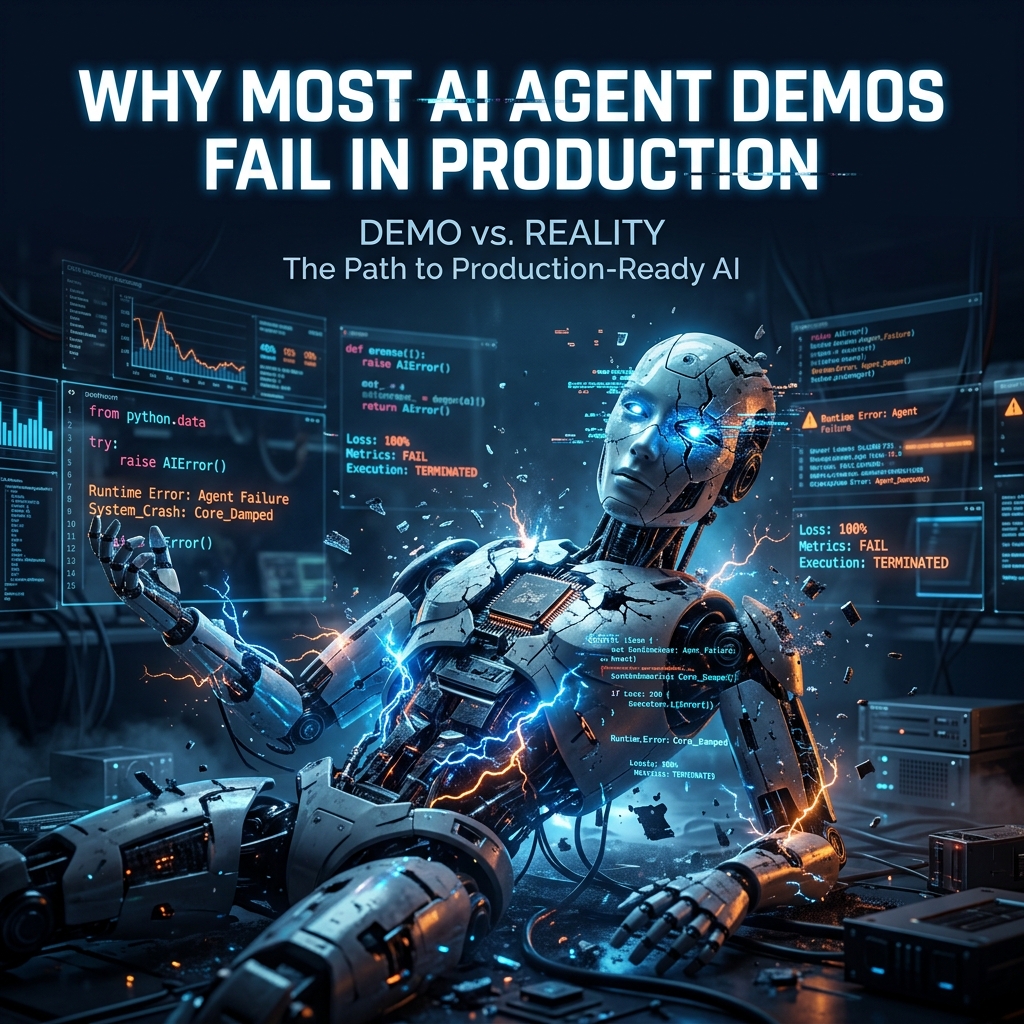
The Prototype-to-Production Chasm
It is incredibly easy to build an impressive AI agent demo in 50 lines of code. However, when these agents are deployed to production, they frequently break, run up massive bills, or get stuck in infinite loops. Understanding why AI agent prototypes fail is the first step toward building reliable, enterprise-grade cognitive systems.
1. The Fragility of Agentic Loops
In a demo, an agent is given a simple task and succeeds. In production, real-world data is messy. If a tool returns an unexpected format or an error, the agent can get confused, retry the same failed action, and enter an infinite billing loop. Production agents need strict token limits, loop-detection middleware, and deterministic safety overrides.
2. Cost and Latency Explosions
Agents that call LLMs recursively inside a loop accumulate costs exponentially. A single user query that triggers 15 agent steps can cost several dollars and take 45 seconds to respond. Users expect real-time feedback. Building hybrid systems—where simple decisions are handled by small, fast models and complex logic is routed to larger models—is crucial.
3. Lack of Continuous Evaluation
With traditional software, unit tests verify correctness. With agents, the output is non-deterministic. A change in a prompt can fix one bug while introducing five others. Successful teams implement automated evaluation pipelines (LLM-as-a-Judge) to test agents against hundreds of golden datasets before every deployment.
To succeed, treat agents not as magic black boxes, but as distributed state machines that require strict boundaries, instrumentation, and fallback systems.